Last updated on September 12th, 2026 at 02:48 pm
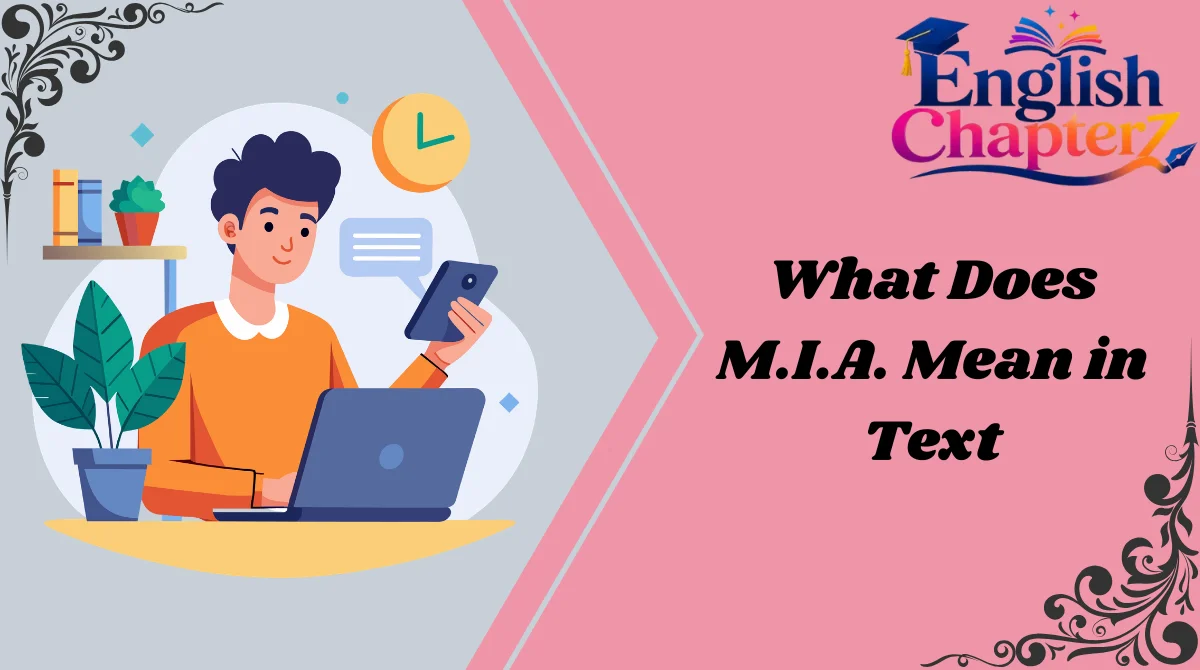
If someone texts you “Where have you been? You’ve been M.I.A.,” you may wonder what they mean by M.I.A. In texting and everyday online communication, M.I.A. usually means “missing in action.” It describes someone who has been absent, unavailable, quiet, or difficult to reach.
The expression is common in casual conversations, social media posts, group chats, and messaging apps. Depending on the situation, it can sound playful, concerned, mildly annoyed, or even romantic.
For example, a friend might jokingly ask why you have been M.I.A. for a week, while someone close to you may use it because they genuinely noticed your absence.
Understanding the surrounding conversation, punctuation, emojis, and relationship between the people involved is the best way to determine the intended tone.
Quick Answer
M.I.A. in text usually means “missing in action.” It describes someone who is absent, unavailable, or has suddenly stopped responding or appearing. For example, “You’ve been M.I.A. lately!” means “I haven’t seen or heard from you recently.” It is usually informal and can be friendly, humorous, concerned, or mildly critical.
What Does M.I.A. Mean in Text?
M.I.A. stands for “missing in action.” In modern texting, it generally means that someone has been absent, inactive, unavailable, or unusually quiet.
When someone says, “You’ve been M.I.A.,” they usually mean:
- You have not been around lately.
- You have not been replying to messages.
- You have disappeared from social media.
- You have not joined the usual group conversations.
- People have not heard from you for a while.
The phrase is often written as M.I.A., MIA, or sometimes mia in casual digital communication. The meaning is generally the same.
How Do You Pronounce M.I.A.?
M.I.A. is usually pronounced by saying the individual letters: “M-I-A.”
For example:
“Where have you been? You’ve been M-I-A!”
In casual speech, some people may also pronounce it as a word, but spelling out the letters is the clearest and most common pronunciation.
What Tone Does M.I.A. Have?
The emotional meaning depends heavily on context. Saying someone is M.I.A. can be:
- Friendly: “Hey, you’ve been M.I.A.! How are you?”
- Playful: “M.I.A. again? 😂”
- Concerned: “You’ve been M.I.A. for days. Is everything okay?”
- Mildly annoyed: “Why have you been M.I.A. all week?”
- Romantic: “You’ve been M.I.A. lately. I miss talking to you.”
- Sarcastic: “Nice of you to finally come back from being M.I.A.”
For example:
Person A: “Sorry I haven’t replied.
Person B: “No worries! You’ve been M.I.A. lately 😂”
Here, M.I.A. is probably being used in a lighthearted way rather than as a serious accusation.
Origin and Background of M.I.A.
The expression “missing in action” has a military background. It traditionally refers to a person, especially a member of the armed forces, whose status is unknown because they cannot be located after taking part in military activity.
The abbreviation M.I.A. developed from this expression.
Over time, the phrase moved beyond its original military context and became a common informal expression. In everyday conversation and online communication, calling someone M.I.A. usually does not mean that the person is literally missing. Instead, it is often a casual way of saying that someone has been absent or out of contact.
The modern texting use is therefore a figurative extension of the original phrase. Someone who has not answered messages, attended social events, or posted online may jokingly be described as M.I.A.
How M.I.A. Is Used in Text Conversations
People use M.I.A. in several ways, and the exact tone depends on the relationship between the people involved.
Friendly and Casual Use
Friends often use M.I.A. when someone disappears from a group chat or has not been around recently.
Friend 1: “Has anyone heard from Jake?”
Friend 2: “Nope, he’s been M.I.A. since Monday.”
This is usually a simple observation rather than a serious complaint.
Humorous Use
M.I.A. can be used jokingly when someone is temporarily unavailable.
“You were M.I.A. during the entire group project 😂”
The speaker may be teasing the person for not participating or being difficult to find.
Concerned Use
Sometimes M.I.A. indicates genuine concern, especially when someone who normally responds suddenly becomes silent.
“You’ve been M.I.A. for two days. Just checking to make sure you’re okay.”
In this situation, the phrase is less about criticizing someone and more about noticing an unusual absence.
Romantic Use
In a romantic or dating context, M.I.A. can suggest that someone has not been communicating as much as expected.
“Hey, you’ve been M.I.A. lately. Everything good?”
Depending on the relationship, this could be a gentle way of saying, “I noticed you haven’t been talking to me.”
It can also express that someone is missed:
“You’ve been M.I.A. I miss our conversations.”
That does not automatically make the phrase romantic, however. The relationship and surrounding messages matter.
Sarcastic or Mildly Annoyed Use
M.I.A. can sometimes communicate frustration.
“Oh, look who’s back from being M.I.A.”
This may be playful teasing between friends, but it could also sound passive-aggressive if the relationship is tense.
What Does M.I.A. Mean on Different Platforms?
The basic meaning of M.I.A. generally stays the same across messaging and social media platforms. However, the context can change slightly depending on how the platform is used.
On WhatsApp, someone may say you have been M.I.A. if you have not replied to messages or have stopped participating in a group chat.
“You’ve been M.I.A. in the family group 😂”
Snapchat
On Snapchat, M.I.A. may refer to someone who has not been sending snaps, responding to messages, or appearing active.
“Why are you M.I.A. on Snap?”
On Instagram, the expression may describe someone who has stopped posting Stories, Reels, or other content—or simply someone who has not been responding to direct messages.
“You’ve been M.I.A. on Instagram lately!”
TikTok
TikTok users may use M.I.A. casually when a creator, friend, or follower has not posted or interacted for a while.
“Where have you been? You’ve been M.I.A.!”
On Facebook, the term can describe someone who has not posted, commented, or interacted with friends recently.
Discord
In a Discord server or gaming community, M.I.A. often refers to someone who has not joined voice chats, responded to messages, or participated in the community.
“Sam’s been M.I.A. from Discord all week.”
Dating Apps
On dating apps, M.I.A. may be used when someone suddenly stops replying or disappears from a conversation.
“You went M.I.A. after we started talking.”
Here, the phrase may carry more emotional weight because it can suggest frustration about a lack of communication or possible ghosting.
What Does M.I.A. Mean From a Girl or Guy?
The meaning of M.I.A. does not fundamentally change based on whether the sender is a girl or a guy.
If someone says, “You’ve been M.I.A.,” the basic message is usually that they have noticed your absence or lack of communication.
What matters more is:
- Your relationship with the person
- How long you have been absent
- Whether you normally communicate frequently
- The punctuation they use
- Any emojis included
- What was said before and after
- Whether the message sounds playful, worried, or frustrated
For example:
“You’ve been M.I.A. 😂”
This is likely light and teasing.
“You’ve been M.I.A. lately. Is everything okay?”
This sounds concerned.
“So you’re just going to go M.I.A. now?”
This could suggest annoyance or disappointment.
If someone you are dating says you have been M.I.A., they may simply be pointing out that you have not been communicating. It does not automatically mean they are flirting or expressing romantic feelings. The broader conversation is the best clue.
Other Possible Meanings of M.I.A.
The meaning “missing in action” is by far the most relevant interpretation when someone uses M.I.A. to describe a person’s absence in casual texting. However, the abbreviation can have other meanings in specific contexts.
| Meaning | Context | Example |
|---|---|---|
| Missing in action | Texting, social media, everyday conversation | “You’ve been M.I.A. lately.” |
| Missing in action | Military context | “Several soldiers were listed as M.I.A.” |
| M.I.A. | Music, referring to the artist M.I.A. | “I’ve been listening to M.I.A. today.” |
| MIA | Place abbreviation for Miami International Airport | “My flight lands at MIA tonight.” |
For ordinary text conversations about someone’s absence, “missing in action” is the most likely meaning.
Context is especially important when MIA appears in a travel, music, or professional conversation.
How to Respond to M.I.A.
Your response should match the tone of the original message. Here are several natural options.
1. Casual Reply
If a friend simply points out that you have been quiet:
“Haha, yeah, I’ve been super busy lately. I’m back now!”
2. Funny Reply
If the message is clearly playful:
“😂 I know! I temporarily disappeared from civilization.”
3. Friendly Reply
“Sorry! Things have been hectic. How have you been?”
This acknowledges the absence and keeps the conversation moving.
4. Romantic Reply
If someone you like says you have been M.I.A.:
“I know, I’m sorry. I’ve missed talking to you too.”
5. If You Were Busy
“Work and school have been keeping me busy. I didn’t mean to disappear!”
6. If You Are Confused
If you are unsure why they said it:
“M.I.A.? What do you mean? 😂”
7. If Someone Sounds Concerned
“I’m okay, thanks for checking in. I’ve just needed some time offline.”
You do not have to give personal details if you do not want to.
8. If You Want to Check on Them
If someone else has suddenly gone quiet:
“I noticed you’ve been M.I.A. lately. Just wanted to make sure everything is okay.”
This is a considerate response when the person’s absence seems unusual.
Similar Texting Terms and Differences
| Term | Meaning | Key Difference |
|---|---|---|
| M.I.A. / MIA | Missing in action; absent or unavailable | Usually focuses on someone being absent or out of contact |
| AFK | Away from keyboard | More common in gaming or online contexts |
| Ghosting | Suddenly stopping communication without explanation | Stronger and usually more negative than simply being M.I.A. |
| Off the grid | Unreachable or disconnected from communication | Often suggests being intentionally unavailable or offline |
| BRB | Be right back | Means the person expects to return soon; opposite of a prolonged absence |
For example, someone can be M.I.A. without necessarily ghosting anyone. A person may simply be busy, traveling, studying, or taking a break from social media.
Common Misunderstandings
One common mistake is assuming that M.I.A. always indicates something serious. In most casual texts, it is simply an informal way to say that someone has not been around.
Another misunderstanding is believing that M.I.A. always means someone is deliberately ignoring messages. That is not necessarily true. A person may be M.I.A. because of work, school, travel, family responsibilities, or simply because they needed time away from their phone.
The formatting can also vary:
- M.I.A. — traditional abbreviation style
- MIA — very common online
- mia — informal lowercase texting
- M.I.A!! — may add emphasis or excitement
- MIA 😂 — likely playful
- MIA lately? — could be a genuine question
The phrase can also be misunderstood when there is no context. For example, “MIA” in a flight conversation may refer to Miami International Airport, while “M.I.A.” in a music conversation could refer to the artist M.I.A.
Is M.I.A. Appropriate or Safe to Use?
In ordinary texting, M.I.A. is generally informal, harmless, and not offensive. It is commonly used among friends, family members, classmates, and online communities.
However, the phrase comes from a military expression connected to people whose whereabouts are unknown during military operations. Because of that background, it may not always be appropriate to use jokingly in situations involving a real missing person or a serious emergency.
For example, if someone has genuinely disappeared and their safety is uncertain, describing the situation as “M.I.A.” in a humorous way could be insensitive.
In a workplace, the expression may be acceptable in an informal chat, depending on company culture. However, in a formal email, clearer wording such as “unavailable,” “absent,” or “I haven’t been able to reach them” is usually more professional.
If a friend or family member suddenly becomes M.I.A. in a way that is unusual for them, especially if there are reasons to think they may be in danger, it is better to check on them rather than assume the phrase is merely a joke.
Examples of M.I.A. in Text
Here are some realistic examples showing different tones and contexts:
- “Hey! You’ve been M.I.A. lately. How are things?”
Friendly and casual. - “Where have you been? You went MIA on us!”
Playful complaint about someone’s absence. - “Sorry for being M.I.A. I’ve had three exams this week.”
Explaining why you have been unavailable. - “You’ve been MIA from the group chat 😂”
Lighthearted teasing. - “I noticed you’ve been M.I.A. Is everything okay?”
Concerned and supportive. - “So you’re just going to go M.I.A. after that message? 😭”
Possibly frustrated or joking, depending on the relationship. - “My best friend has been MIA all weekend.”
Describing someone’s absence to another person. - “You were M.I.A. yesterday. I tried calling you.”
Pointing out that someone was unreachable. - “Sorry I disappeared for a while. Life got hectic.”
A natural response without using the abbreviation itself. - “He’s been MIA since he started his new job.”
Explaining why someone has become less available. - “Girl, you are MIA! Come back and tell us everything 😂”
Playful and friendly. - “You’ve been M.I.A. and I kinda miss our late-night chats.”
Potentially affectionate or romantic, depending on the relationship.
Frequently Asked Questions
What does M.I.A. stand for in texting?
M.I.A. stands for “missing in action.” In texting, it usually means that someone has been absent, unavailable, quiet, or difficult to reach. The expression is often used casually and does not necessarily mean that the person is literally missing or in danger.
Does M.I.A. mean someone is ignoring you?
Not necessarily. If someone is M.I.A., they may simply be busy, offline, traveling, studying, or dealing with personal responsibilities. The phrase describes their absence but does not automatically explain why they are absent. If you need to know whether someone is intentionally ignoring you, you need to consider the broader conversation and their behavior.
What does “you’ve been M.I.A.” mean?
“You’ve been M.I.A.” usually means “I haven’t seen or heard from you lately.” The speaker has noticed that you have been absent or less communicative than usual. Depending on their tone, it can be friendly, concerned, teasing, or mildly annoyed.
Is M.I.A. the same as ghosting?
No. M.I.A. simply means someone has been absent or unavailable, while ghosting usually refers to abruptly ending communication or repeatedly ignoring someone without explanation. Someone can be M.I.A. because they are busy without intentionally ghosting anyone.
What does M.I.A. mean from a girl or guy?
The basic meaning is the same regardless of the sender’s gender. If a girl or guy says you have been M.I.A., they are usually pointing out that you have been absent or quiet. Whether the message is friendly, romantic, sarcastic, or concerned depends on your relationship and the surrounding context.
How should I reply when someone says I’ve been M.I.A.?
You can respond according to the situation. For a casual conversation, try, “Yeah, I’ve been busy lately!” If you want to be funny, you could say, “I’m back from my disappearing act 😂.” If the person sounds concerned, reassure them that you are okay and explain as much as you feel comfortable sharing.
Conclusion
In text messages, M.I.A. usually means “missing in action” and describes someone who has been absent, unavailable, or unusually quiet. It can be friendly, humorous, concerned, romantic, or mildly annoyed depending on the context.
The relationship between the people, punctuation, emojis, and surrounding messages can all affect the tone.
If someone tells you that you have been M.I.A., they are generally saying they noticed your absence. A simple explanation, joke, or friendly update is usually enough to keep the conversation going.

Ethan Wordsmith is a passionate English language writer who enjoys exploring words, phrases, texting abbreviations, slang, and modern digital communication. Through clear and easy-to-understand content, he helps readers discover the meanings and everyday uses of English language terms.